
Attractions

Vegas Indoor Skydiving

200 Convention Center Dr.
Las Vegas, NV 89109
(702) 731-4768
Map it

Flyaway Indoor Skydiving

Vegas Indoor Skydiving Details

  • Hours of operation: Open daily, 10 a.m. - 8 p.m.
  • Cost: 
    • $75 - first flight
    • $40 - repeat flight (additional flights purchased on the same day as the single flight)
    • $200 - five-flight book (for use by one person only)
    • $325 - 15-minute block party (15 minutes of private use of the wind tunnel, may be shared by up to five people, includes video service)
  • Payment options: Cash, traveler's checks, MasterCard, Visa, American Express and Discover.
  • Reservations: Not available.
  • Location: Located just off the Las Vegas Strip, south of the Riviera Hotel & Casino on Convention Center Drive.
  • Age/Height/Weight restrictions: Those under 18 years of age must be accompanied by a parent. Participants' height and weight must be proportional and they need to be in good physical condition with no medical, drug or alcohol problems. Socks and soft-soled shoes are a must. No sandals or open-toed shoes are allowed to be worn in the wind tunnel for safety reasons.

Vegas Indoor Skydiving Review

Despite the deafening roar tearing through the walls at Vegas Indoor Skydiving in Las Vegas, a young couple strolled in recently and asked the cashier where to register for the 2 p.m. skydiving class.

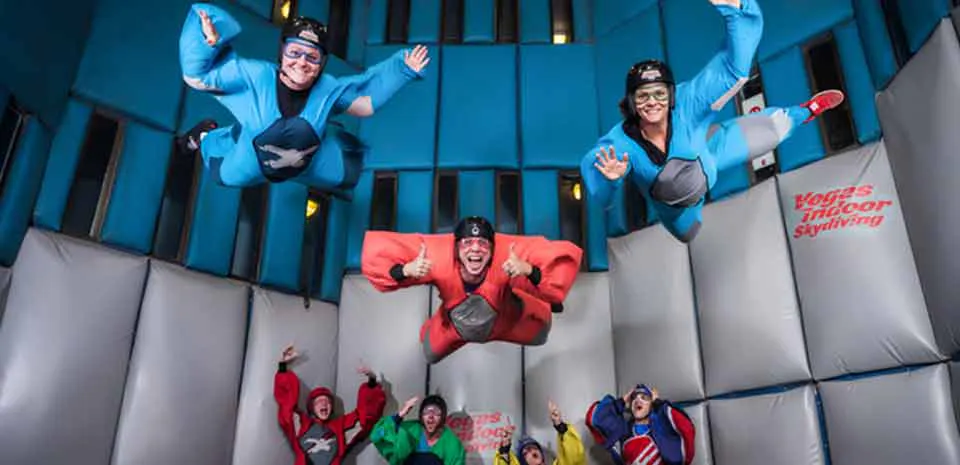
Within 20 minutes the two were briefed on the most effective crash position and dressed in oversized flight suits, joining three other students in a 12-foot-wide, 22-foot-high padded tunnel.

Certainly not everybody wants to jump thousands of feet from an airplane. For the curious, yet not entirely daring, there's indoor skydiving.

No inclement weather. No worries about a parachute not opening. No birds-eye views of faraway ground.

"The great thing about this is that a 5-year-old can do it, and Grandma can do it," Diana Adams, manager of the facility, said. "You just need to come ready to have fun."

The attraction, on 200 Convention Center Drive, draws 30,000 curious locals and tourists each year, including experienced skydivers who use the wind tunnel for practice.

"The sensation is the same as when you are skydiving," Adams said. "You feel an awesome wind coming up at you."

A DC-3 propeller at the base of the wind tunnel generates winds up to 120 mph. Anyone within the provided restrictions can fly. Customers are served on a walk-in basis only. A frequent flyer program offers discount rates for flights.

"We have junkies," Adams said.

Aside from a video demonstration and a quick briefing from the instructor who is on hand in the tunnel, there is little preflight preparation.

"A lot of people think it's a ride," Adams said. "We tell them it's not. They're going to be flying. They're going to be falling." Caution signs posted throughout the building warn of the risks involved.

Las Vegans Jan Jenkins and John Butler read a two-page waiver -- which flyers must sign -- with little hesitation until they came across the words "plummet uncontrolled."

"Will you catch me if I fall?" Jenkins asked Butler.

"No," Butler said. "But I'll take your house."

After watching the video, the two jokingly agreed with other group members that jumping out of an airplane is preferred to indoor skydiving.

"No broken bones," Butler said. "It's safe to say you're just going to die."

Moving on, Butler, Jenkins and the rest of the group walked to the next room, where 17-year-old instructor Scott Wilkins had set out flight suits.

After slipping into her blue flight suit, Hilary Brougher, visiting from New York City, told Ethan Mass, her husband of two days, that she was a Power Ranger, referring to the live-action cartoon characters, then fitted goggles over her head.

It was Mass and Brougher's first flight. They came to Vegas Indoor Skydiving on the advice of a friend who recently became an enthusiast after his first flight in the wind tunnel.

"It seems like the type of thing you want to come back and get better at," Mass said. "And you don't have to wait for the plane to take off."

After a few more tips from the instructor, group members took turns demonstrating their newly learned flight position on a wood bench in the center of the room.

Having passed the course, with their goggles, elbow pads, ear plugs and helmets issued, the group followed Wilkins down a hallway and then climbed into the tunnel.

The blue decagonal tunnel is reminiscent of a scene from Stanley Kubrick's "2001: A Space Odyssey." Looking into the tunnel from the windows on the observation deck, one can imagine Johann Strauss' waltz, "Blue Danube," playing as the goggle-faced adventurists learn to fly.

"The most important thing is to relax," Wilkins told them before they suited up.

The second most important piece of advice: Tuck and roll. "You guys will be falling," he said. "It's very important to tuck and roll."

When crashing this maneuver is likely to prevent broken bones, he said. The method involves forming the body into a ball when falling. Wilkins advised the group to practice it before they actually started flying.

With little hesitation, group members threw themselves into the padded walls and cushions surrounding the outer base of the tunnel. They bounced on the wire netting separating them from the propeller directly below.

Once Wilkins entered the tunnel, the wind-control operator started the propeller, and a hurricane-like wind shot him skyward. He flew back down, bounced on the wire net and turned midair somersaults before demonstrating the comparatively modest flights the students would take.

Taking turns, he led each flyer onto the netting, put them face down, then let the wind lift them 7 feet in the air. Wilkins held on to the flyers, keeping them centered in the tunnel -- an effort that resembled ballet, but with helmets and chin guards.

For the next 15 minutes they took turns diving into the wind from the tunnel's side cushions, floating on its force.

Mass motioned that he'd like to fly to the top, but the wind gusts provided to beginners couldn't lift him that high. Someone weighing 130 pounds would be flying at wind gusts only 75 to 80 percent of the maximum speed, roughly 90 mph, Adams said.

"Once they know how to tunnel fly we set it to maximum speed," she said.

But mastering flying isn't something anyone is going to do in the first session, she said. "It takes a lot of body control."

"Every little thing not symmetrical is going to affect your flight," she said. "It's like riding a bicycle. It's a balance that kind of clicks."

Had anyone flown to the top on their first visit to the tunnel? "Not on purpose," Wilkins said.

Because of the risks and athleticism involved, some chose to sit through training class and decided not to fly.

"You need to be in fairly decent shape," Adams said. "You're going to be sore the next day. You're using muscles you don't normally use."

Publicized skydiving feats (from an airplane) by President George Bush (the elder) in recent years have drawn a new audience to skydiving, both the indoor and outdoor varieties.

"Since George Bush jumped we've had more seniors (at the facility)," Adams said.

Adams has jumped 230 times from a plane, and she said the only difference between skydiving and flying in the wind tunnel is that the tunnel has "lift rate," meaning it lifts the flyers from the ground. Skydiving, naturally, has "fall rate," meaning divers fall toward the ground.

Also, an average free fall from an airplane lasts 45 to 50 seconds, while flyers in the wind tunnel spend three minutes in the air.

"People picture skydivers as crazy maniacs, but skydiving is a relaxing, serene sport," she said. "People do this for relaxation."

The tunnel is one of few in the country. Its sister facility is in Pigeon Forge, Tenn. The Army uses a wind tunnel at Fort Bragg, N.C., to train its skydivers. Meanwhile, mobile vertical-wind tunnels can be found at amusement parks throughout the country.

Rod Driver came to Las Vegas from England specifically to learn "sky surfing" at Flyaway Indoor Skydiving.

Sky surfing involves flying with a board strapped to the feet and requires more body control than skydiving, Driver said. "And there's no safe way to learn out of an airplane," he said.

Surfers who attempt to tackle it from the sky risk getting "helicopter momentum," which causes the attached board to twirl like a propeller, Adams said. Many end up having to abandon their board in midair.

Driver prepared for a practice flight with his board as Jenkins and Butler ditched their flight suits and goggles and headed toward the door.

"That's just too much fun," Jenkins said. "We're coming back. Probably next week."

-- Staff Report